
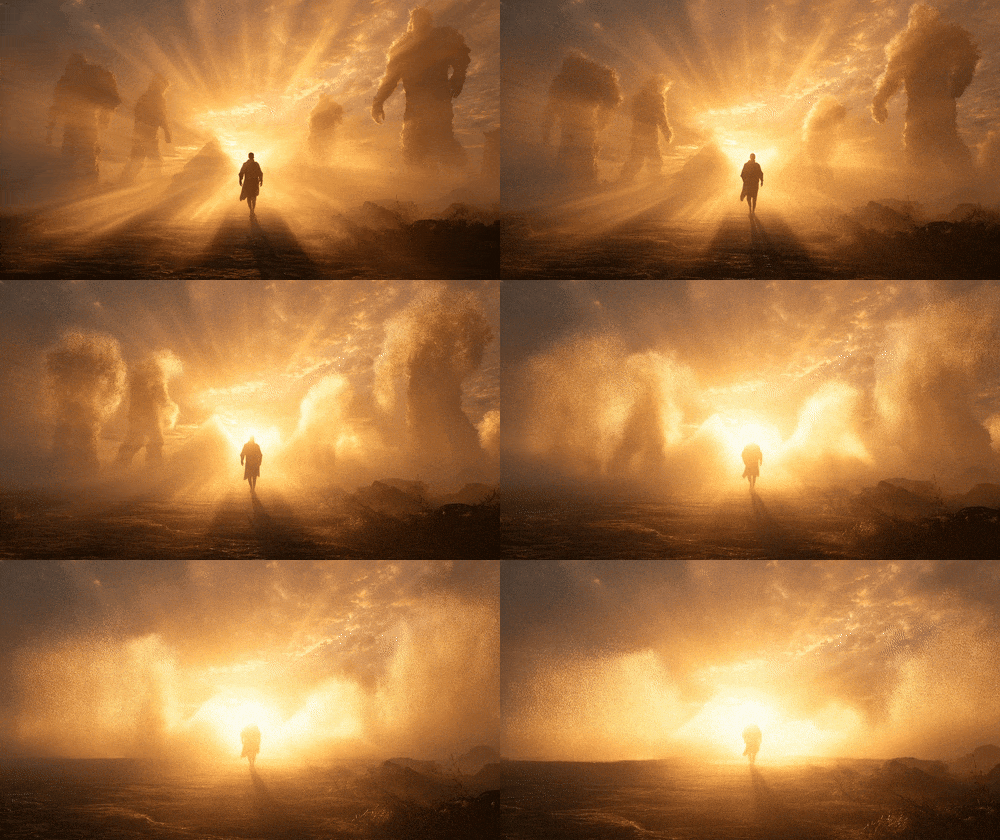
Before Israel marched into the Promised Land, the night was full of whispers.
Stories passed down through generations spoke of ancient warriors. Towering. Menacing.
Their graves were said to stretch like scars across the land. Their memory clung to valleys and fortified cities like cold mist that wouldn't lift.
They were called the Rephaim.
Some were flesh-and-blood giants. They were massive warriors you could actually fight.
The most notorious was ‘Og of Bashan,’ a king so impossibly large that Moses himself paused to note the dimensions of his iron bed: thirteen feet long. Six feet wide (Deuteronomy 3:11).
The kind of detail you record when you need people to believe you're not exaggerating.
But here's where it gets eerie:
Scripture also uses the word Rephaim in a darker register. In Job, the Psalms, and Isaiah, the Rephaim are described as ‘the shades.’ The departed dead. Ghostlike voices that linger long after death.
Not quite living. Not quite gone.
The Rephaim lived in two realms at once: as literal enemies occupying the land and as symbolic reminders of the past that haunts the imagination.
I think that's exactly why we need to talk about them.

Ancient Jewish writings leaned into this eeriness, musing that the spirits of old giants clung to the world after death.
Whether or not those traditions are literally true doesn't really matter. They capture something profoundly true about how we experience life:
Not all giants stand in front of you. Some stand behind you.
You know them, don't you?
• Old wounds that still ache when the weather changes
• Old patterns you swore you buried years ago—but somehow keep resurrecting
• Old voices that whisper you're not enough, you never were, you never will be
• Old failures reminding you of everything you didn't become
These are the Rephaim of the heart.

Ancient Jewish writings leaned into this eeriness, musing that the spirits of old giants clung to the world after death.
Whether or not those traditions are literally true doesn't really matter. They capture something profoundly true about how we experience life:
Not all giants stand in front of you. Some stand behind you.
You know them, don't you?
• Old wounds that still ache when the weather changes
• Old patterns you swore you buried years ago—but somehow keep resurrecting
• Old voices that whisper you're not enough, you never were, you never will be
• Old failures reminding you of everything you didn't become
These are the Rephaim of the heart.
Check them out before anyone else by going to our channel at PRAY.COM
Plus, you'll find more resources to build your faith, right from your phone.

Israel had to face their Rephaim before they could step into God's promise.
The last and greatest of these giants was King Og of Bashan. He was a living relic of an older, darker age.
And God made sure that the battle was won decisively, almost theatrically.
"We utterly destroyed them." (Deuteronomy 3:3-6)
Why? So that generations later, when Israel's children asked, "Did we really defeat the giants?" the answer would be unmistakable: Yes. Completely. God made sure of it.
God didn't just tell Israel, "Ignore those giants. Pretend they're not there. Think positive thoughts."
No. He said, "Face them. Fight them. And watch Me defeat them."
Because you can't move forward while constantly looking over your shoulder.
You can't step into your future while the ghosts of your past are still whispering in your ear.
At some point, the Rephaim have to be confronted.
But we worship a God who specializes in bringing down giants.


