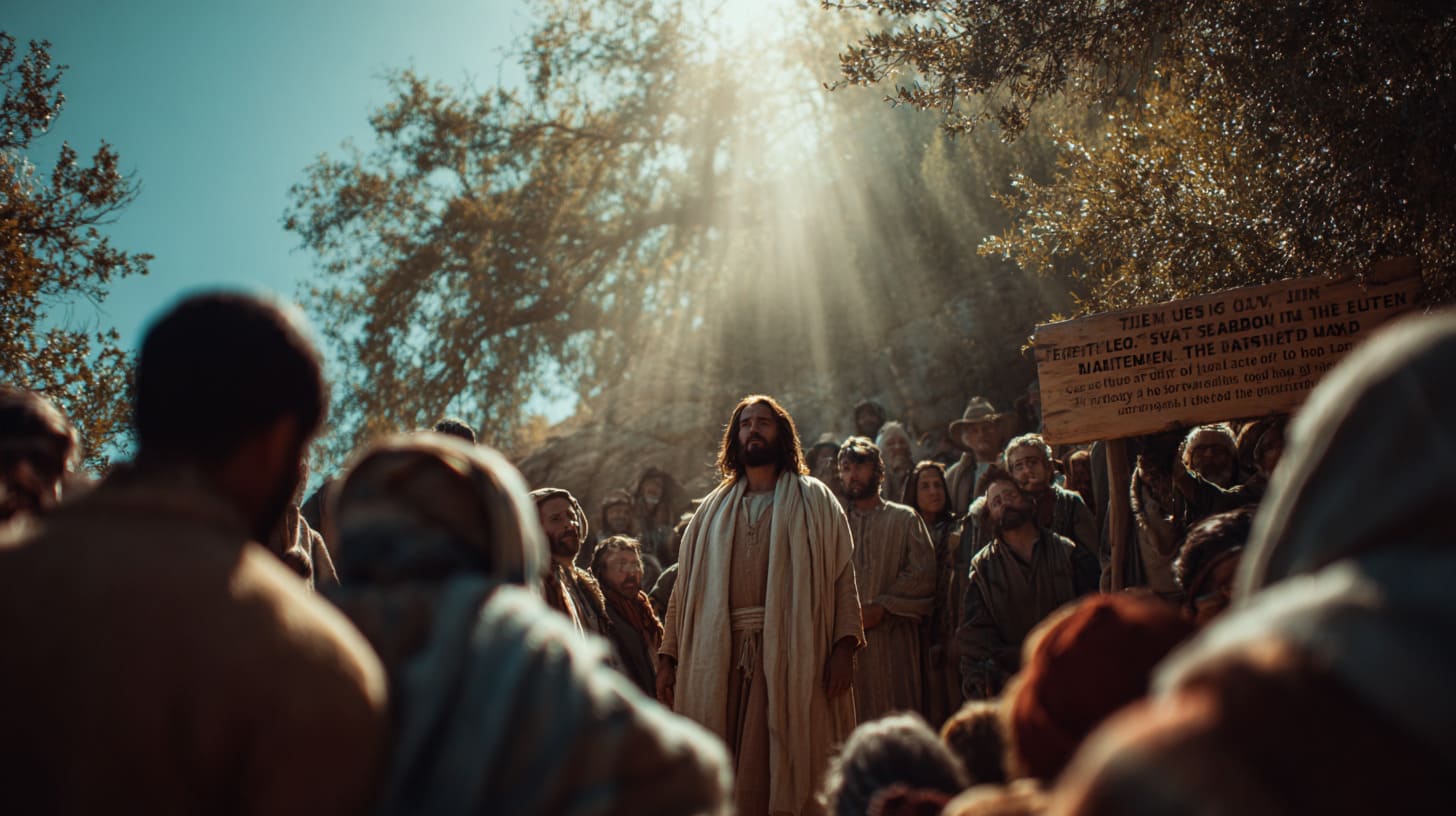
For so long, everyone has been asking us to animate the entire Bible. And now, through PRAY.COM and Bible in a Year, we’re finally making our dreams come true!
Starting January 1st, we’ll be embarking on a journey through the entire Bible, animating every major story with cinematic storytelling and deep reflection.
Keep an eye out in your inbox for our new name, “Bible in a Year.”
We couldn’t be more thrilled about this new, epic adventure through the Bible.
Every day, we’ll send you a new video on the Bible, accompanied by in-depth reflection and our signature AI Bible style.
So, as we build up to this epic launch, let’s ask the question… What is the Bible, exactly?

If you begin reading Scripture from page one, you encounter an unfolding story: creation, rebellion, rescue, covenant.
But by the time you reach Exodus, you’re knee-deep in ancient laws. Over 600 of them. Some feel familiar and just. Others feel odd… foreign… and maybe even creepy.
So the question naturally arises for Christians today: Are we supposed to follow the Old Testament Law?
To answer, we need to understand what the Law is, why God gave it, and how Jesus completes the story it tells.
The Bible is not a behavior manual. It is an epic narrative about God restoring creation through His covenant people. And in that story, God does give commands… but always with purpose.
After God rescues Israel from slavery, He forms a covenant with them (Ex. 19–24). Think of it like a marriage vow:
God commits Himself to His people, and Israel commits to living under God’s wisdom, expressed in the Law.
The laws provide examples—case studies—of what living as God’s set-apart people looked like in that ancient culture.
The laws were good (Ps. 19:7). They expressed divine ideals like justice, holiness, mercy, and trust. But woven through the narrative is a painful truth: Israel, like Adam and Eve, struggled to trust God’s wisdom.
Their story becomes a cycle of failure, grace, and exile. The Law revealed God’s character—but also humanity’s inability to keep covenant on our own.

Okay… But what about the "strange" laws? Laws about not mixing fabrics and shunning bacon?
Think about it this way… Israel existed in the ancient world, where warlords, famine, conquest, and natural disasters could topple a people-group within weeks.
If God’s people were going to survive the ancient world, they had to be distinct. They needed an identity that was so unique, it could exist in the wilderness beyond Canaan or in Babylonian captivity.
This nation, with its hand-washing rituals and aversion to bat meat, was preserved by its laws. It survived when other nations rose and fell like flies.
All this was for a purpose… Israel was the Chosen Nation where the Messiah would come, under Roman oppression.
Israel’s unique identity was preserved through its “odd” laws.
There were also laws about justice, sacrifice, and family. Laws preserved the home, atoned for sin, and pointed forward to Christ.
Animal sacrifices symbolized God making a way for sinful people to dwell with Him (Lev. 1–7). A blameless life ascended where humans could not.
Laws about fairness, protection of the vulnerable, sabbath rest, and economic mercy embodied the truth that every person is made in God’s image (Gen. 1:26–27).
Even the laws we struggle with—like regulations about slavery—are, in context, limiting and undermining injustice, pointing Israel toward greater freedom.
Check them out before anyone else by going to our channel at PRAY.COM
Plus, you'll find more resources to build your faith, right from your phone.

When people ask whether Christians should follow the Old Testament Law, the answer often gets tangled because we forget what the Law is doing inside the story of Scripture.
The Law never appears in a vacuum. It shows up after God rescues a people, after He brings them out of slavery, after He invites them into a covenant relationship.
In that context, the Law is not a burden. It’s a gift.
Not a checklist. A way of life.
A picture of what it means to belong to a holy God.
But as soon as the Law is introduced, the story also shows Israel breaking it. Not because the Law was flawed, but because the human heart was.
That tension runs from Eden to Sinai to the prophets who cried out for something deeper than external obedience. They longed for transformed hearts.
And that longing leads us straight to Jesus.
Jesus didn’t arrive to tear the Law down. He came to bring it to its intended goal. His life embodied the very ideals behind every command—mercy, justice, covenant faithfulness, wholehearted love.
And then He did something the Law alone could never do:
He sent His Spirit to change the heart.
That’s where the shift happens for Christians. We are not entering the Sinai covenant. We’re entering the new covenant promised by the prophets—a covenant where obedience flows from the inside, not from external regulations.
We don’t ignore them, and we don’t try to reenact them. Instead, we read them as wisdom within a story that finds its completion in Christ.
Christians aren’t asked to keep the entire Torah, because it belonged to a covenant we are not under.
However, we are invited to understand it, learn from it, and let its underlying vision of God’s holiness and love shape us as the Spirit leads.
In other words, the Law points us to Jesus, and Jesus leads us into the kind of life the Law was always aiming toward.