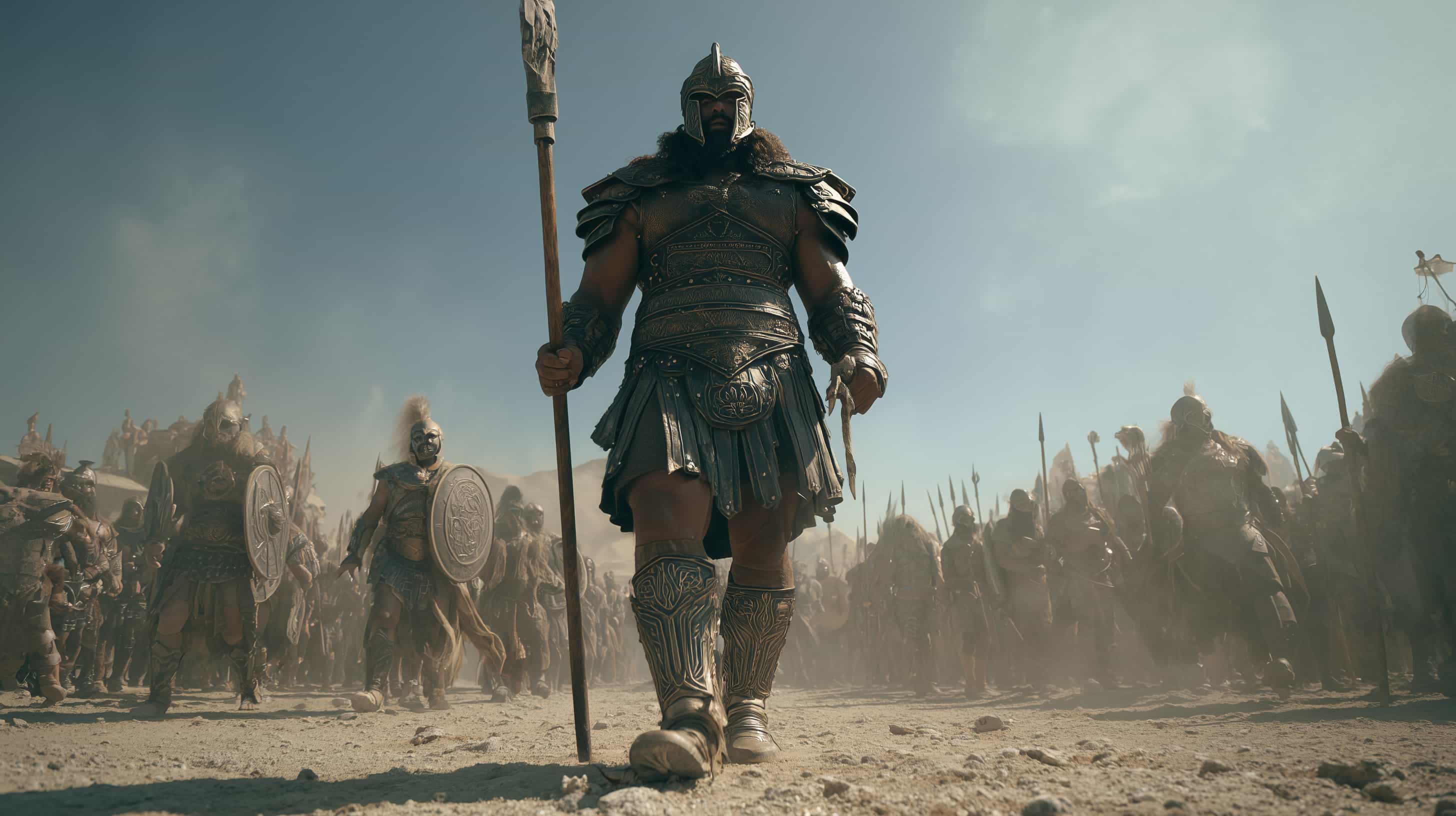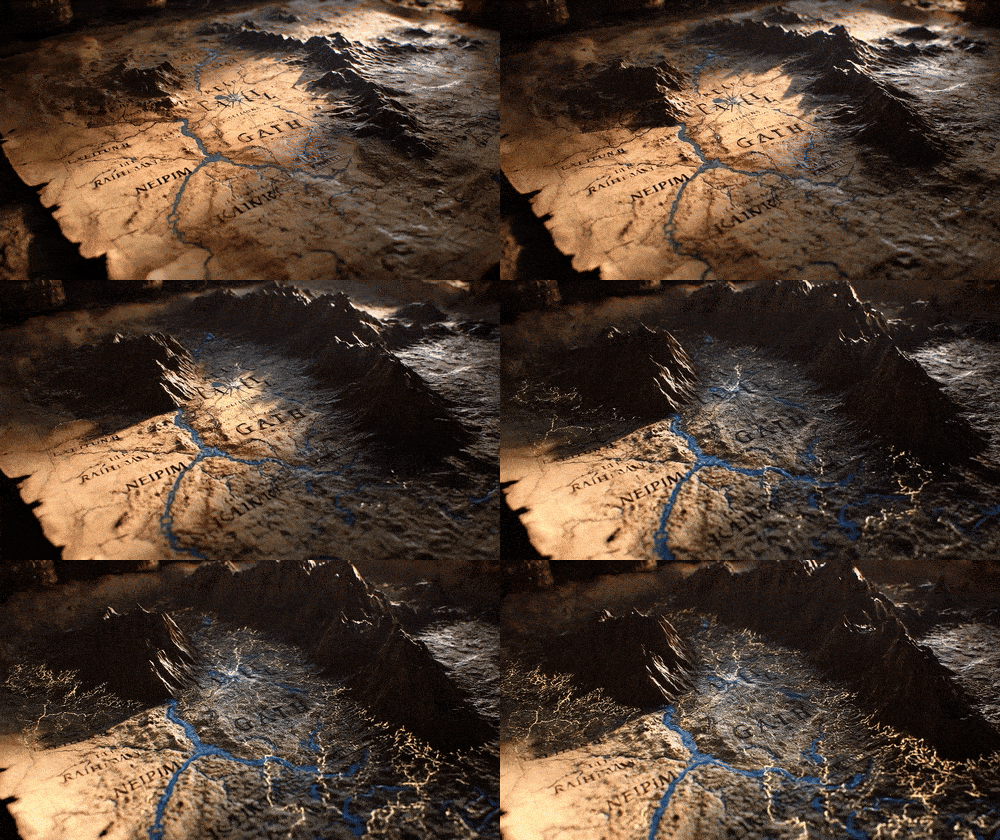
Scripture introduces Goliath with surgical precision:
"A champion named Goliath, who was from Gath..." (1 Samuel 17:4)
Gath.
Not just any Philistine city, but the city. It was the very place Joshua failed to purge of its Anakim giant remnants. (Joshua 11:21–22)
In the biblical imagination, Goliath isn't simply armed with sword and spear.
He's armed with memory. Memory of the ancient giant clans Israel was commanded to destroy, but never quite finished off.
He's a living artifact of pre-flood echoes and Canaanite dread, standing there in the Valley of Elah like a monument to unfinished business.
He defies Israel's army. He defies Israel's God.
And the biblical author wants you to feel the weight of this: Goliath is more than "a big dude with an attitude." He's the looming continuation of a spiritual war that started long before David was even born.
There’s a lot of lore behind Goliath of Gath. Ancient Jewish thinkers spent endless hours speculating, searching, musing…
The Midrash makes a stunning claim about Goliath’s origin:
It claims that Goliath was the son of Orpah, Ruth's sister-in-law.
Let that sink in for a moment.
Think about the poetry of this. The tragedy of it.
Ruth follows Naomi back to Bethlehem and becomes the great-grandmother of David.
Orpah kisses Naomi goodbye, turns back to Moab, and becomes the mother of Goliath.
Two Moabite women. Two choices. Two destinies. Two bloodlines that collide generations later in a valley, with the fate of Israel hanging in the balance.
According to the lore, Orpah weeps when she parts from Naomi. Those tears—symbolically—become the seeds of her giant offspring. She bears four sons, corresponding to the four Philistine giants later slain by David and his men in 2 Samuel 21.
Is it literal history? Probably not.
Is it brilliant? Absolutely.
Because the midrash transforms the David-Goliath duel into a cosmic family drama. David embodies faithfulness to Yahweh. Goliath embodies the rejection of Him.
A covenant child faces a son of apostasy. Destiny meets destiny. Light confronts darkness.
And suddenly, the story feels mythic, fated, electric… like it was always going to happen this way.

If you want your head to spin, stay with me here.
The Bible records multiple giant tribes scattered throughout the ancient Near East: the Nephilim in Genesis 6, the Anakim in Numbers 13, the Rephaim in Deuteronomy 2–3, and others like the Emim and Zamzummim.
Most were wiped out during Joshua's conquests… Except for a small remnant.
And where did that remnant settle?
Gath, Gaza, and Ashdod. (Joshua 11:22)
Where is Goliath from? Gath.
Now put the pieces together:
Goliath is a champion from Gath.
This is why scholars across Jewish, Christian, and even secular traditions argue that Goliath was likely one of the last descendants of the Rephaim-Anakim lineage.
The theological implication is staggering: David is slaying the final echo of an ancient, corrupted bloodline that once terrorized the land.
The showdown becomes apocalyptic in scope: the shepherd boy versus the last titan of a fallen age. The future king of Israel versus the living remnant of everything God commanded His people to eradicate.
Check them out before anyone else by going to our channel at PRAY.COM
Plus, you'll find more resources to build your faith, right from your phone.

When you stitch together the biblical text, ancient geography, theological patterns, and Jewish lore, you discover something profound:
Goliath is not just a Philistine bruiser with good trash talk. He is a remnant of ancient giants. A symbol of pre-Israelite corruption. A product of generational spiritual rebellion.
His fall is a pivotal moment. Yahweh extinguishes the last glowing ember of Canaan's ancient darkness.
David's stone ends a story that began long before he was born.
And it begins a new one—a kingdom, a lineage, a promise that would one day culminate in another Son of David who would face down death itself and emerge victorious.
The shepherd who slew the giant became the king.
And the King who descended from that shepherd became the Savior.